Not the Fight I Came For…

This morning I arrived at the pond where the wild horses drink to hoping to get more stallion fighting shots. I do have some recent ones. That will be the teaser. Not much action from the horses today but there were a lot of birds to watch at the pond. White-faced Ibis, Dunlins, Avocets, and Long-billed Dowitchers and Black-necked Stilts.

The Black-necked stilts provided the drama much to my surprise. Two Stilts, and it is easy to see how they got their names on those impossibly long legs, were peacefully probing the mud flats for their breakfast when this other male flew noisily in and started attacking one of the other males. It really was quite a show. When I got home and started editing the photos I saw how truly violent this episode was. If you look closely you can see that one of the Stilts has pierced the other’s neck with his long sharp beak. Ouch!

Success with My New Blind

I recently bought a new photographer drape from Naturescapes and put it to the test today. It is ideal for photographers and is well designed for taking wildlife pictures. It is made with Camouflage material and has an opening for your lens to poke out. Camo netting allows you to look out over your lens and see everywhere except directly behind you. There is ample material for covering you and your tripod mounted camera standing or sitting. I have been anxiously awaiting a chance to try it out.

I arrived at a Sage grouse Lek this morning well before dawn and set it up. I was a little too far from the grouse for great pictures but something else happened that saved my day.

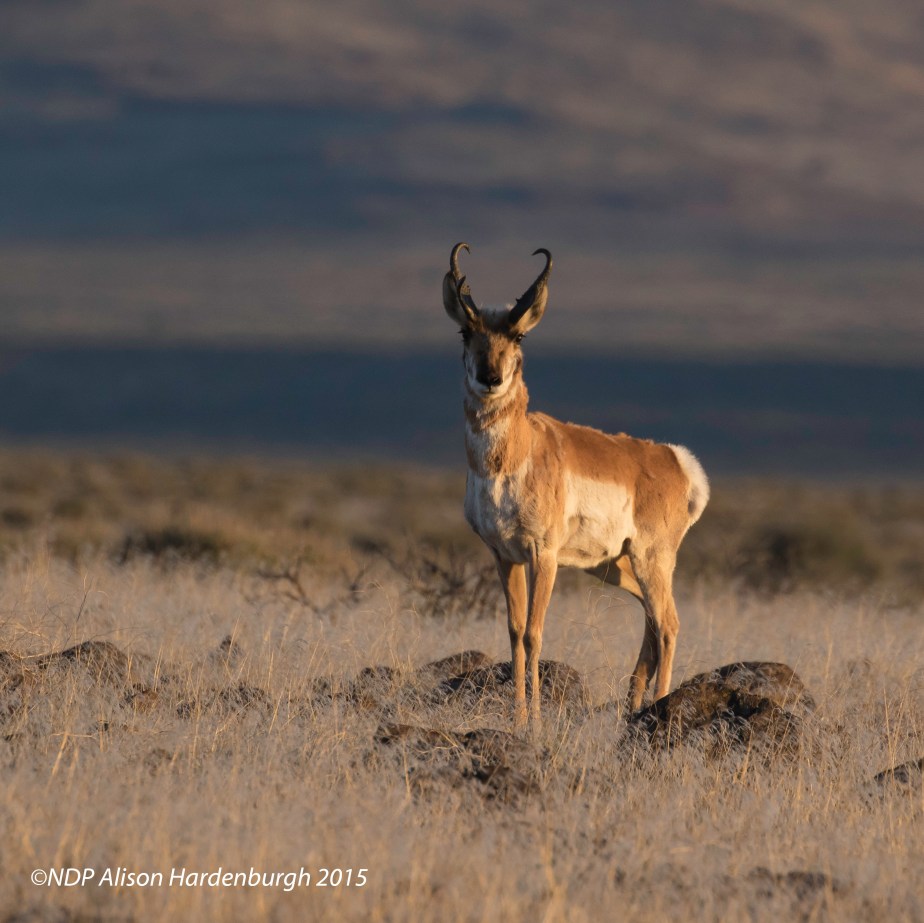
As it began to get light I saw larger flashes of white in the distance and soon was able to make out that they were Pronghorn or antelope. They have amazing vision and they picked out from a distance my blind because I had to move in it, and were spooked and ran off at first. I settled in to take photos of the birds which is what I came for anyway. Then the good stuff happened.

The birds never caught on to my presence and they strutted and danced on the Lek for several hours. The antelope circled back not once but four times and actually approached me and the blind coming in very close. The sound of the camera clicks, and I did have to swivel the lens from time to time, alerted them that something unusual was up but I believe that because they did not see a human shape they were more curious than alarmed. They were extremely curious and I was surprised how many passes they made by the blind. At one point they marched right through the strutting Sage grouse neither party taking much notice of the other.

This was a thrilling experience for me as antelope are difficult to get close to. You can take photos of them from your car fairly often but it does not have the same thrill as being up close to them in their environment. Looking forward to trying this out on more antelope and other species soon.

Wild Burros

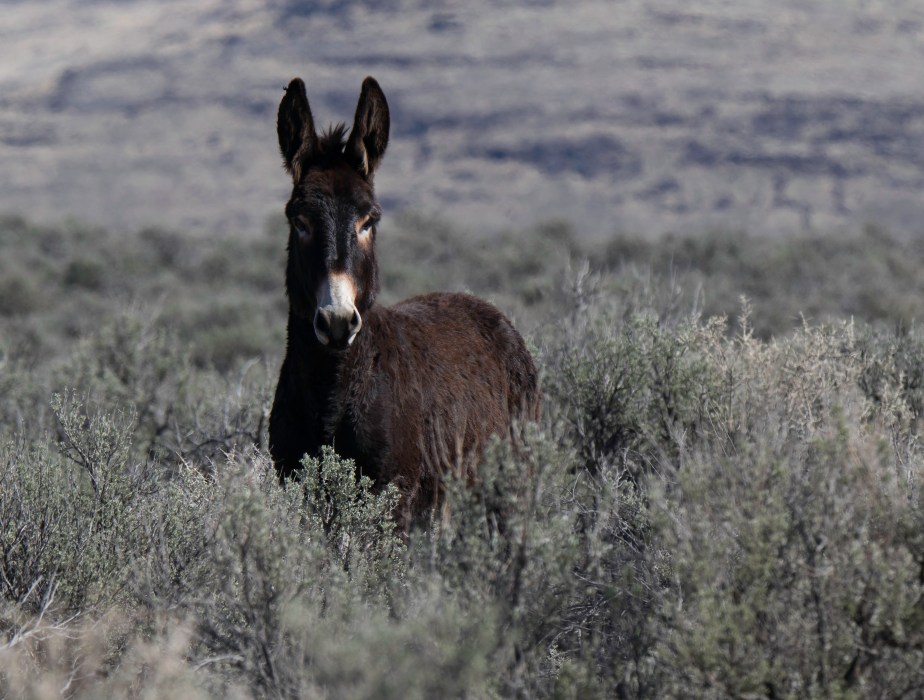
The American West is home to Mustangs, feral horses and the less glamorous wild Burro. These Burros came to North America with the Spanish explorers, miners and settlers and like the wild horses, some escaped or were let loose. Over the course of time they thrived and multiplied. They don’t get as much attention or press as wild horses do. They don’t have the Hollywood looks and appeal that horses have.

I run across them from time to time and the foals are about as cute an animal as you will ever see. They are very fuzzy and look like a plush stuffed animal. Driving back from Alturas, California a few weeks ago, I spotted this small band close to the highway so I took a detour to photograph them.

They were pretty spooky, or at least the Stallion was. He tried to intimidate me and drive his mares off but everyone settled down fairly quickly and I was able to complete a short session. The Stallion is the big dark colored burro and actually I think he is quite handsome.

While Burros are not native to North America they have done very well here and current wild populations are estimated at about 20,000. They are a desert animal so the arid west is a natural place for them to live. They do need water, just not as much as other animals. Wild Burros can lose as much as 30% of their body weight through dehydration, and replace it in only 5 minutes drinking. (Humans require medical attention if 10% of body weight is lost to dehydration and require a full day of intermittent drinking to replenish this loss.) They do need to have a water source within 10 miles.

Hopefully I can find a band this spring with a foal and update with a photo of one of the cute little ones.

Northern Harriers

As I work on bird in flight photography, I am having a bit of a love affair with Northern Harriers. They are as hawks go, fairly accommodating for the photographer. Their habit of gliding low to the ground over marsh land makes them much easier to photograph than say a high flying Red-tailed hawk.

I discovered that the Swan Lake nature study/refuge area north of town is a favorite haunt of these birds. The refuge is just under 2000 acres and surrounded by warehouses and neighborhoods. They built a long dock-walkway out into the middle of the marsh and standing on this puts you right in the middle of the action for Harriers as they hunt.

Northern Harriers are easy to identify. They have an owl shaped face. This shape helps funnel the noises of voles and mice to them which are their principal prey. The females are brown in color and the males are grey to white.

There are quite a few of these hawks frequenting the swamp. I hope the action continues through the year. They are fun to practice flight photography on and beautiful to watch.

Kiger Mustangs

I spent a few days at Frenchglen Oregon this last week and paid a visit to the Kiger Mountain BLM Herd Management area to get a look at the famous Kiger Mustangs that reside there. These horses are unique in that they are true Mustangs descended from the Spanish Barb horses brought to North America in the 17th century. I don’t use the word Mustang in relation to the wild or feral horses I usually take photos of because they are not truly Mustangs but rather a mix of domestic stock that one way or another has over the years become wild and proliferated all over the West.

The Kiger herd was discovered in roundups in the 1970s, the horses have distinct characteristics that set them apart from other horse types. They were genetically tested and their DNA proved that they were Mustangs; a bloodline that was thought to have disappeared from America’s wild herds. These horses are carefully managed and protected to preserve our heritage. They are kept separate from other feral horses to keep the bloodlines pure. They are fenced in two very large management areas and are still truly wild.

I had to use a lot of patience to get close to them. The Stallion was especially protective and he charged out aggressively when he saw me to make sure that I was not a threat to his band. Very slowly and in a roundabout way I worked my way up to them. Once I was among them they relaxed like most of the feral horses I photograph and did not pay much attention to me other than some curious looks with pricked up ears which makes for good pictures.

I had heard these horses were different, very beautiful and they are! They are mostly a dun color though other colors are allowed, there was a grulla mare in the band I found, (mouse gray) and I saw in this little herd, most of the identifying characteristics that set them apart. They have primitive markings like a dorsal stripe down the back, some zebra striping on the legs, some have two colors in their manes and black points. They are fine boned and refined looking. They have nice heads and are short backed, overall good confirmation with an athletic look. Looking at the photos I think you will readily see the difference in the Kigers from other feral horses. The Kiger horses were used as inspiration for the animated film that DreamWorks created, “Spirit, Stallion of the Cimarron, made in 2002. The stallion in the band I observed looked very much like the animated character, Spirit.

These horses were very alert especially the Stallion. While watching them I saw them notice some antelope in the far distance and they were very interested in their movements. After I had spent some time with them, the stallion charged up the hill after something he had seen ready to do battle. I never saw what he saw, maybe a coyote, but the herd followed him and I let them go at that point and hiked back to my car.

Amazing New Lens

After months of researching, saving and trading in old equipment, I was able to cobble enough money together to buy the Tamron 150-600 telephoto zoom lens. It arrived on Monday and I have been able to take it out a few times and I am impressed. I probably could never save up for a Canon prime 500 or 600 lens or justify spending that kind of money so I was praying that this Tamron would be an answer for me. I have it paired with the Canon 7dMark II.

All wildlife and bird photographers want more reach. You always want to get closer and fill the frame with your subject. Birds especially are challenging as they are so small in the frame if you don’t get close enough.

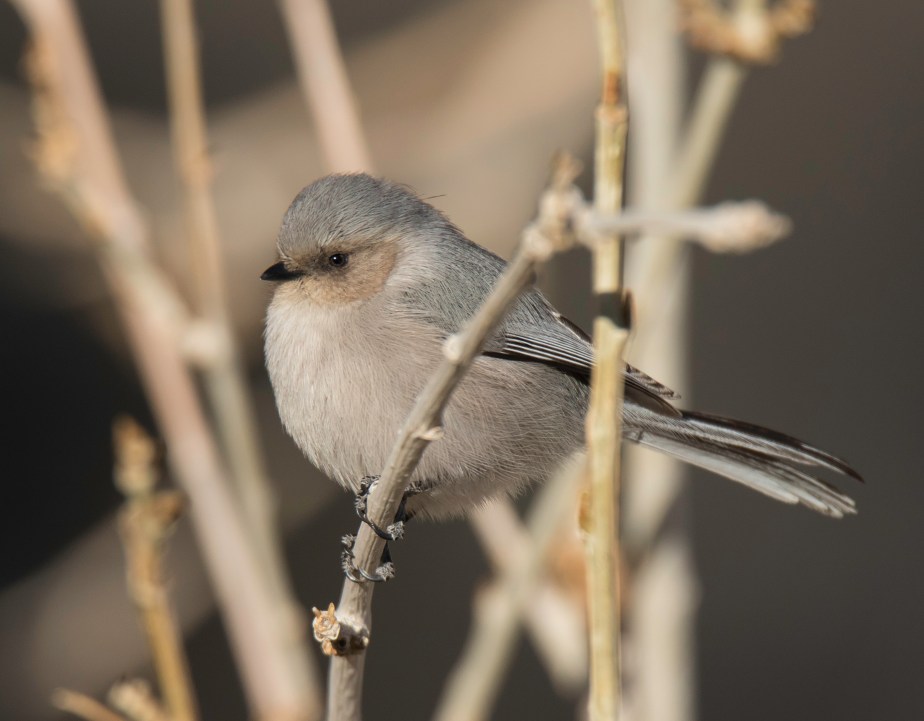
This morning I tried it out on one of the tiniest of birds I know, the Bushtit, and I am very happy with the results. These birds are so small and fast moving that to get a good photo of them is very difficult or at least I have always found it so. They are lively little things and flock in large noisy social groups and I think I have several good photos here that demonstrate how sharp this lens is. All of these were taken at 600mm.

I took a pretty good photo of a Mountain Bluebird sitting on a bird house yesterday also at 600mm. I don’t see any softness with these photos at 600mm. The Mourning dove was on my fence in the backyard and was also taken at 600mm hand held.

I took this in flight photo of a Northern Harrier which is not sharp but that was operator error. The Tamron is so light at just over 4 pounds that you can hand hold it for bird in flight photos. Someone let me take some photos with their Canon 600mm prime once and I think without a tripod I could not take any photos at all.

Can’t wait to take this new lens up to Klamath and on a Sage Grouse trip I have planned for next month.

Winter in the Klamath Basin

The Klamath Basin National Wildlife Refuge is a large complex of refuges on the California/Oregon border. Every winter over 500 Bald Eagles choose to winter here because of the abundance of wintering snow geese and tundra swans that use the refuge through the winter. A couple of years ago I made several trips up there to photograph wildlife but never made it back in 2014. I got a new lens and could not think of a better place to try it out so I made a quick trip up there last week. I think I got a pretty good representation of the wildlife you can find on the refuge in the photographs I took.

Great Blue Heron
Great Egret
Bald Eagles
Mule Deer
Coyote
Red-tailed Hawk

The Challenger

I took my new 7dmarkII out for its second test run Saturday and got lucky with some action at the water hole. In spite of the wet, cold, weather we have been having, the wild horses are still frequenting the pond. It started out boring with just one lonely bachelor hanging around but soon got very interesting. This young stallion had decided he was ready to take on the big boys and he challenged each stallion who showed up escorting his mares to drink.

Some of the skirmishes were short and it didn’t seem as if the older horses were taking the challenger too seriously. One stallion was not in the mood for the young bachelor and they had several encounters that were interesting to watch.

Most of these fights take a predictable path. The herd stallion runs out to meet the threat, any sexually mature male, they usually sniff noses followed by squealing or roaring and some hoof play and or nipping. Often that’s it and the bachelor runs off; end of drama.

The challenger, I will call White Socks as he has four white socks, was not running off. He was particularly vexing for this bay stallion who was not amused at his nonsense. They mixed it up several times without anyone getting hurt and no lost mares for the Bay.

The bay displayed most of the classic herd stallion behaviors. He moved his mares off and then turned to meet White Socks. In the photo with his head down he is “snaking” the mares out of the way.

Not all the pictures are in good focus. I need to work on that. Still getting to know the camera. The 7dII by the way is able to handle all the fast action without pausing. I will have to watch that. The editing was a real chore. 😉

Happy Thanksgiving

It has become a tradition for me to make sure I spend Thanksgiving morning out enjoying nature as being able to immerse myself in the natural world is an aspect of life I am most grateful for. I had an awesome morning. The mule deer rut is in full swing so I donned all my camo and got out to the river before it got light. I included a couple of photos of me in my camo as some folks have asked to see it. It is far from flattering or fashionable attire but I think you can get an idea how effective it is when seen against a sagebrush backdrop. I bathe in scent killing soap, wash my camo in scent neutralizer and use scent elimination spray before heading into the brush. It certainly worked this morning.

I passed a band of wild horses feeding in a meadow by the water as I made my way deeper into the river bottom. Noting their location I was reassured that no matter what happened I wouldn’t get skunked for photo ops today.

I had not seen any deer as of yet and the woods were quiet. I wondered if I was going to see any deer. I was setting up my tripod and deciding where I should plant myself at the intersection of deer trails and all of the sudden the area was alive with deer. I had a spike and a small two point walking through a small grove of cottonwoods and heard more deer crashing around in the high grass about 75 yards to my left. I could see the large rack of a 4 point over the tops of the grass as he was chasing some does around but could never get a clear photo of him. Meanwhile the two smaller bucks just ignored me as I stood still and shot away at them. The two point heard the camera clicks and was alert to something amiss and never showed himself fully but the spike eventually lay down in the grass close to me but not where I could photograph him.

Something startled all of them at one point and they all ran away. It wasn’t me. Maybe a coyote or another hiker along the trail I hadn’t seen. I sat down in the sagebrush to wait for everything to calm down. A few minutes later a doe came charging through the brush and almost collided with me. We were both startled! Behind her a smaller 4 point came into the clearing so close I couldn’t get a photo. He saw me but couldn’t quite figure me out. He ran off and I got the slightly blurry photo of him as he scrambled off.

I decided to walk through the woods toward the place I had seen the horses. Looked into a thicket of young cottonwoods and saw a sleepy Great Horned Owl. Was able to take a few photos without disturbing him and moved on to the horses.

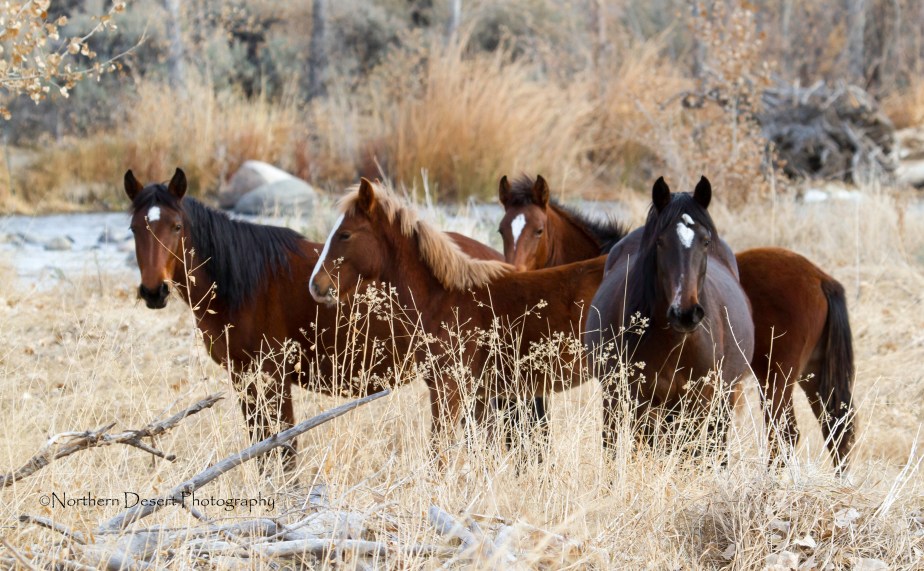
I have seen this band before and the herd stallion is a particularly good looking flaxen chestnut. He has passed his coloration on to his son complete with white blaze. The other looker in the band is a seal brown mare with a broken star on her face. I got some mediocre photos of the horses the grasses were in the way of some of the shots but all in all a very good day.

A perfectly happy Thanksgiving morning for me.

I love My Camo!

Last year I watched the Outdoor channel a lot getting ideas from hunters about how to get close to animals especially deer. I watched a lot of archery deer hunting shows with my finger on the remote and clicked away as the hunter released their arrow. I can’t watch the kill shot. I am not anti-hunting as long as hunting is done legally and responsibly I don’t have a beef
So I made several trips to the Sportsman Warehouse and got some good desert Camo, pants, jacket, face mask, hat, the works. After studying the archery hunters I learned about scent killing techniques as well. Back to Sportsman’s for special soap, detergent, even mouth wash to neutralize human scent. This stuff is amazing! I have had deer walk right by me without knowing I was there. I can’t always get a picture but have had many heart pounding moments. Sometimes they catch a whiff or sense something is not right and bound off but when everything works right it is pretty exciting.
I took this photo of a nice sized Mule deer buck the day after my coyote trapper encounter. I got out to the river around dawn and sat with my back to some sagebrush along a heavily used deer trail. Within 15 minutes of sitting down I saw this buck coming my way. He never saw me. He looks like he sees me in the photo but that alert, ears up look is from him hearing the camera clicks. He kept coming and walked within 20 feet of me. Actually he got too close for my lens.
I am sure I look ridiculous when I am in my camouflage but I almost feel like I have the power of invisibility. I sat in a bush at another location and had a flock of shy, tiny birds land all around me very close to me as they did not realize I was there.
I am learning the value of sitting very still in a zen like state, patiently waiting for what will come rather than hurrying around trying to find what is out there. Please, just don’t send me a mountain lion. 😉