I have been involved with conservation organizations in Nevada for a long time. I love our public lands, and Nevada, with 48 million acres designated as public, has the vast majority of public land in the United States. I choose to live in Nevada primarily because of access to huge areas that were set aside for public use. It is rare for me to come across a no trespassing sign which can be all too common in states that don’t have a large amount of public land. The BLM, the Bureau of Land Management is responsible for managing these lands for multi-use purposes.
I wrote this article for a sportsman’s publication, and it was published this fall. It isn’t an in depth look at the wild horse issue but was designed to be informative on a basic level. There were a few graphs and tables which I am not including. I am going to write a series of essays on the topic which will look at some of the problems with wild horse populations exploding on our public lands. If you are an anti-management “advocate” of wild horses and drinking the Kool aid that animal rights extremists are serving, feel free to unfollow me and move along. With all the changes coming to the Department of the Interior, the BLM and new appointments to key positions, I want to put down my thoughts as we move forward in uncertain times.
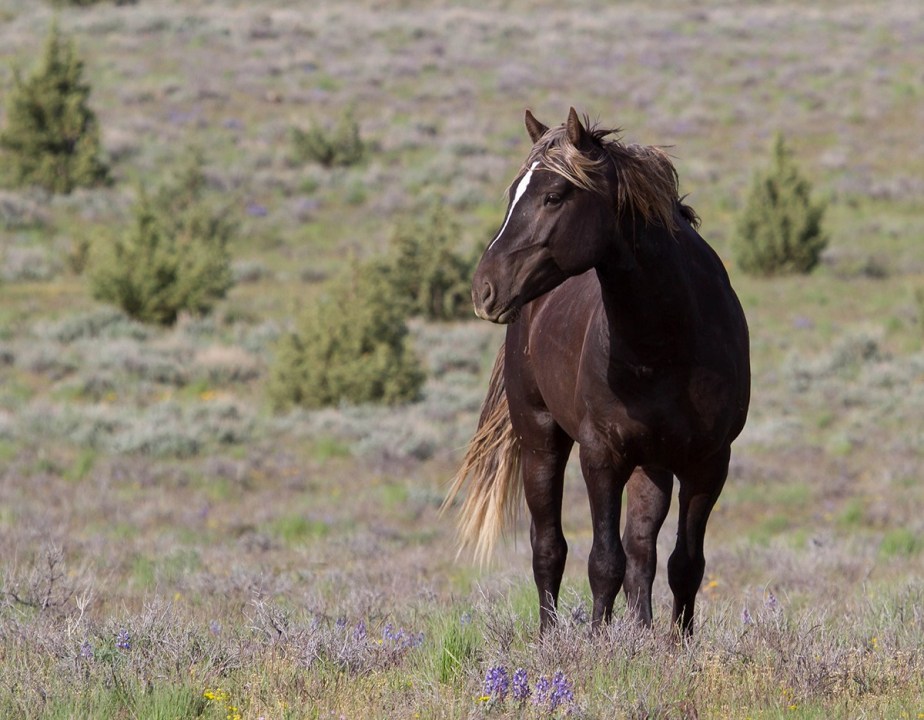
The horse in the feature image is a healthy horse on a properly managed range.
Wildhorse Management for Healthy Rangelands and Wildlife
Nevada is the driest state in the United States. It’s vast stretches of sagebrush steppe are some of the largest undisturbed swaths of Sage Grouse habitat left in the West. Many big game animals and unique bird, fish and amphibian species make the mountains and basins of Nevada home. As a state mostly made up of high desert, water and forage are the limiting factors for the viability of all living things on the landscape. All animals, plants and birds depend on and share the often, scarce resources.
Wild horses and burros also have their place out in the wide-open spaces on our State’s public lands and are legally protected by the passage of the Wild and Free-Roaming Horses and Burros Act of 1971 (WFRHBA). Familiarity with the law regarding wild horses and burros is a great starting point for those who would like to educate themselves about wild horse management and is available to read online.
Horses and burro numbers managed to the original (AML)s, appropriate management levels, would be ideal and solve many of the problems we are seeing with degradation of habitat and critical riparian areas that are essential for all wildlife. Nevada has the privilege and burden of having the largest populations of wild horses and burros in the U. S. There are 177 (HMA)s, Herd Management areas, and Nevada has 77 of them. When the (WFRHBA) was passed, the carrying capacity or number of wild horses in Nevada was set at 12800. While this number fluctuates with gathers and foaling, the current number of horses in Nevada is approximately 40,000 horses and 4685 burros. Obviously, the number is far above the original number set which has contributed to degradation of rangelands and negative impacts to our native wildlife.
If the BLM were allowed to gather the horses and get the number of wild horses and burros down to AML in every HMA, the ability to use fertility control instead of gathers would be a real possibility. With numbers far above AML this is not a practical or workable solution. Fertility control can help to stabilize populations but is not effective in reducing them.
What can we do as sportsmen and women to ensure that balance is maintained on our public lands? We must be a strong voice for responsible management of the horses and burros along with all wildlife on the lands managed by the BLM. Balance must be achieved and then maintained to protect the health of our rangelands, wildlife and yes, even the horses themselves. There are many opportunities to engage in positive action:
- Write your Legislative Representatives asking for responsible Wild Horse and Burro Mangement. Ask that priority is made in budgets for management.
- Respond to Public Comment requests from the BLM on planning for Herd Management Areas asking for responsible management.
- Attend public meetings such as the Wildlife Commission meetings and make public comments.
- Educate yourselves and others on Wild Horse and Burro management issues.
- Make observations when in the field and report any issues you are seeing to appropriate partes, BLM and NDOW for example.
- Engage with and support efforts by the sportsmen organizations that are striving for balanced management of our resources and wildlife.
- If you are able, and need a new ranch, pack, or hunting horse consider adopting a horse from the BLM adoption program. They are sturdy and sure footed and could fill that spot in your string.
End of article.
More to come on the cruelty of mismanagement by advocacy groups.
This horse is in bad shape due to an over population of horses on the Virginia Range. Many of the horses in the Virgina range are healthy but they are rapidly headed for a population crash. The fertility control is not effective. I will write more about this management debacle later.
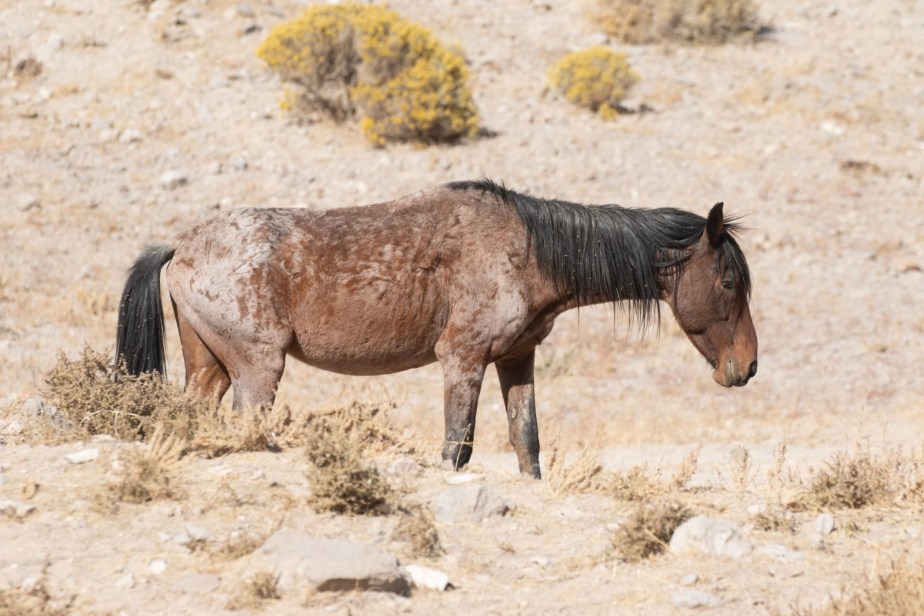
This Virginia Range horse is one of many displaying a painful skin condition. Because these horses are wild this kind of condition is almost impossible to treat. The condition may be the result of overpopulation and poor feed. The BLM does not manage the Virginia Range horses, Advocacy groups and the Nevada Department of Agriculture have a cooperative agreement. I alerted the group that manages these horses about this situation, and nothing has been done to help this horse.


 Northern Desert Photography
Back in the day, I was called a tree-hugger. I commend you for all you do. Wild horses deserve to stay that way!
Are you arguing for more BLM intervention in your HMAs?
Indeed I am. The horses are destroying riparian areas and out competing native wildlife. I am working with wildlife biologists and rangeland scientists. The proof is irrefutable.
Thanks for this, ND. We need all perspectives on topics like this in order to arrive at reasoned, balanced solutions. Fanaticism has never, ever solved a problem. It’s inherently sticky when humans are forced to “manage” other species out of human-created problems.
Although I’m well aware of the US Government’s sordid history of predator extermination, I’m not anti-BLM. I’ve seen well-managed lands here in Washington with thriving ecosystems. But let’s face it, a truly healthy ecosystem doesn’t need to be “managed.” I realize that’s an idealistic statement in our current world, but I think it also bears looking at when we’re seeking solution-oriented paradigms.
On that note, I’m curious how you answer the argument of anti-culling groups that the cattle industry’s carte blanche to use public lands for grazing puts pressure on horse populations (and the ecosystems in general)? In the absence of cattle grazing (including the water-draw from cattle) could the land support a larger horse population?
As an exercise in thinking outside the box, I like to look at what worked pre-colonization, ask myself what isn’t working now and then question what our obligations might be in light of that disparity. Doing so inevitably raises ethical questions of the sort that, in my observation, only “animal rights extremists” are willing to ask. This is why I have respect for them as well.
I don’t disagree with anything you’ve said. I just think we also need to take a long, hard look at ourselves. With so many land use and environmental conundrums of our day, as long as we continue to assume it’s a human right to do basically whatever we want for our own short-term benefit, we’ll be faced with making unpleasant decisions about “managing” other species.
But then, you’re talking to someone who thinks Vegas should be converted to a wildlife refuge, LOL! 😉 (I’d settle for a moratorium on all-you-can-eat crab buffets.)
Thanks for a thought-provoking post.
Phew… glad I haven’t lost you. Great questions. These are all questions that I and others struggle with on a daily basis. I have answers that I plan on sharing with my readers if you can stay tuned. This is such a complex problem and each one of your thoughtful responses is something to carefully consider and answer. I am not a person who loves writing but when I dropped this here, I planned on going the distance. This is born out of extreme frustration with misinformation and politics. Thanks for reading and asking probing questions. 😉
You’re most welcome, ND! You’re living in the thick of this controversy, so your opinions are valuable to me. I’m always one to try to get to first principles when it comes to these types of questions. I’m a big believer in that legendary quote of Einstein’s “You can’t solve a problem with the same mind that created it.”
These issues ultimately are the products of ways of thinking that may be outmoded, but which are so deeply entrenched in our psyches, that we’re hard-pressed see around them. I try to deal with this briefly in my short essay “The Unsouling of the World”:
Thanks for taking this subject on in a well-reasoned manner. I will definitely stay tuned. 🙂
A very pertinent article. We are going to have a similar conversation on our nature reserve here about wild goats. You can either have a nature reserve or too many wild goats, you can’t have both. I hope that your conversation can continue without bad faith on either side.
Fascinating! Please keep us posted on the wild goat issue. I had no idea that you faced this same type of environmental problem. Would love to hear more about it and how it gets resolved. My sister and I hiked the West Highland Way a few years ago and ran into wild goats above Loch Lomond.
It is a curious fact that people who can quite happily live with the annual cull of the thousands of sheep on our hills for the meat market can get quite worked up about a very small cull of similar animals, which will also go to the meat market.
Indeed. I feel the same way about the cattle that graze our public land and are regularly sent to slaughter. They are as sentient as horses but don’t have the romance factor, so no one spares them a thought.
But those horses can be alive in changing climate-if yes, then I agree with you,Dear ND.❣️🙏❣️
❤ ❤ ❤
SO so beautiful!
Thanks for covering this controversial topic, Alison. I have seen the damage “wild” horses and domestic livestock can do to desert environments if not properly managed. Here in eastern Oregon, we have a very small population of wild Kiger Mustangs. Some display dorsal and zebra stripes. We tried to find them once, but didn’t see any.
Thanks. I have photographed the Kiger horses and they are a special herd. More to come on this topic. I am glad I haven’t alienated you with bringing it up. There are so many well-meaning but uneducated people interfering with proper management I fear for the environmental future of Nevada.
I’m jealous of you for seeing the Kiger herd. We may head over that way soon.
A beautiful opening photo ~ wild horses seem to capture the spirit of the past which we’ve forgotten in modern times. It is much needed to have such reminders of such days, as it is good for our spirit as well. You are doing such great work, and like the others here, I admire it. Well done, and take care! 😊